
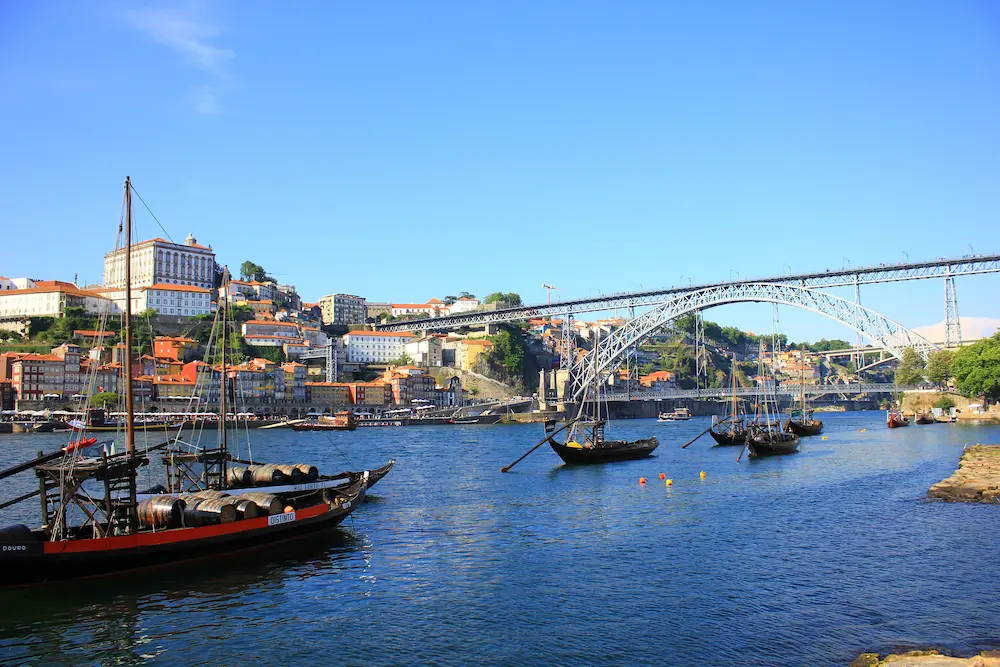
Luís I Bridge
The best known and most famous of all the bridges in the city, and one of the most beautiful bridges in Europe. Inaugurated in 1886, 395 meters long, 8 meters wide, two platforms and one of the largest wrought iron arches in the world. It was designed by Théophile Seyrig, a former partner of Gustave Eiffel. The pedestrian top deck is 390 meters long, connecting the area of the "Invicta" Cathedral with Morro Garden, with the municipality of Vila Nova de Gaia, a beautiful viewpoint, linking the yellow metro line. The 174 meter long lower deck is both used for traffic and pedestrias. This bridge, together with the Clérigos Tower, are iconic to Porto.
Maria Pia Bridge
D. Maria Pia bridge is a railway infrastructure over the Douro river, between the cities of Porto and Vila Nova de Gaia. Inaugurated on November 4th of 1877 and deactivated on June 24, 1991. 114 years of history that ended when it could no longer meet the demands of the evolution of rail transport, being replaced by the São João bridge. When inaugurated, it was the bridge with the largest iron arch in the world and an engineering work that surprised the world, together with the Garabit viaduct, as one of the greatest masterpieces executed by Eiffel and co and classified as National Monument since 1982. Up until today, its 160 meter long arch, located 61 meters above the river, never seizes to impress. The bridge was named in honor of the wife of King D. Luís I, Queen D. Maria Pia of Saboya and allowed the arrival of the railway to the city of Porto, an achievement of great importance for the region's economy. It is the oldest bridge that can be seen on the 6 Bridges Cruise tour.

Infante Enrique Bridge from the Luis I Bridge.
Infante D. Henrique Bridge
Infante Dom Henrique bridge, also known as Ponte do Infante, is a road bridge that connects Vila Nova de Gaia with Porto, over the Douro River. Its name honos Henry the Navigator, who was born in Porto on March 4th, 1394. It was built upstream in the heart of the historic center of Porto, to replace the upper deck of the Luís I Bridge, converted for use by the "Line Yellow" of the Porto Metro. Inaugurated in 2003, it took 27 years to build with a 280-meter concrete arch, which reaches 72 meters high, 371 meters long and 20 meters wide, two lanes each side. The Infante Bridge is one of the largest single-story arch bridges in the world and considered by some experts as one of the most elegant of its kind. The youngest of 6 bridges and links Fontainhas neighborhood with the beautiful mountainous area of Serra do Pilar, in Vila Nova de Gaia.
Arrábida Bridge
Arrábida bridge was the second traffic used to be built between Porto and Vila Nova Gaia. A National Monument since 2013, it stands out for its grandeur and dimension, standing 70 meters above the level of the Douro River. An arch of 270 meters and at the time of its construction in 1963, the bridge had the highest reinforced concrete arch in the world. The bridge had two carriageways and two side lanes for pedestrians and cyclists that were changed in the 90's to increase the number of highway lanes and facilitate road traffic. A project conceived by Edgar Cardoso. This bridge is an outstanding architectural work in Porto and is crossed daily by thousands of vehicles, establishing a connection between the Campo Alegre area, on the “Invicta” side, and Arrábida, on the Gaia side. It is the closest bridge to the Atlantic Ocean and was the first of all the bridges over the Douro to be designed and built entirely by Portuguese engineering. Formerly it had four elevators so that pedestrians could cover the distance of seventy meters from the river to the bridge that stopped working in the mid-90s, but in the elevator towers of this work of art, four ornamental sculptures of five meters high, cast in bronze. Two on the Porto side, and two on the Gaia side.

Arrabida Bridge
São João Bridge
São João bridge is a railway infrastructure that came into service on June 24th of 1991 precisely on the day of Saint John (São João), an immensely popular and beloved saint in the area. It is one of the most modern bridges in Porto and replaced the neighboring Maria Pia bridge as the rail link between the "Invicta" city and the destinations in the south. Built in reinforced concrete, it is another outstanding work of architecture in Porto. A project directed by Edgar Cardoso, that unlike other bridges built to date over the Douro River in Porto, the São João Bridge has a central arch of 250 meters, which set a world record for rigid frame bridges. The three arches are supported by two imposing pillars, built on both sides, while the total length of this railway bridge is 969 meters. Since 2020, high-speed train services have been running on this bridge, through Porto-Campanhã railway station, the most important long-distance and high-speed train station in the city.
Freixo bridge.
Freixo bridge is a connecting highway between Vila Nova de Gaia and Porto across the Douro River. Actually two bridges built side by side, with a separation of 10 cm from each other, in reinforced concrete and along a length of 750 meters. A road bridge with eight traffic lanes (four on each side), but with much lower deck than the other bridges that connect Porto with Vila Nova de Gaia. A project by António Reis and Daniel de Sousa used daily by thousands of vehicles, establishing a connection between the areas of the Dragão Stadium, in Porto, and Oliveira do Douro, in Gaia. The furthest from Atlantic Ocean bridge seen from the 6 bridges cruise. It was inaugurated in September 1995 and built as an attempt to minimize the car traffic congestion experienced on the Arrábida and Luís I Bridges, particularly noticeable since the late 80's.
.webp)