
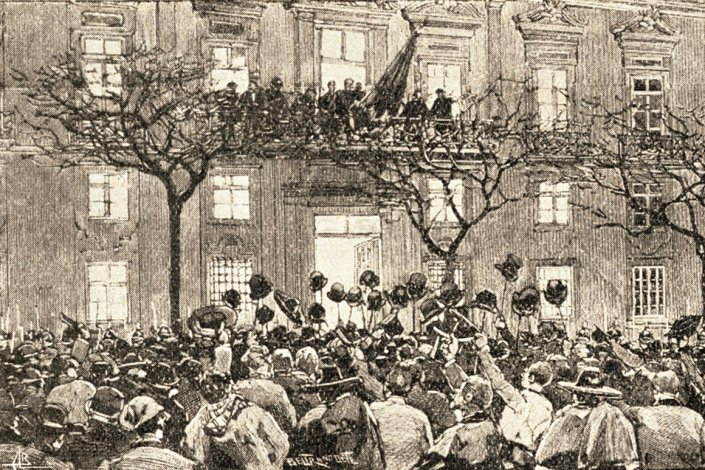
The republican uprising of January 31, 1891, in Porto.
At the end of the 19th century, Portugal was occupying some African territories between Angola and Mozambique. On January 11, 1890, the British government sent a memorandum to Portugal, threatening to cut diplomatic relations and even hinting at a possible military intervention if Portugal did not withdraw its armed force presence in the center of Africa. The humiliation of having to accept the resolution and withdraw from those territories caused members of the government to resign one by one, and unleashed strong political and social discomfort in the country. The Portuguese Government's quick surrender to the ultimatum threw the country into a deep crisis.
This gave rise to radical patriotic and anti-British sentiment, initially shared by monarchists and republicans, which quickly spread also through public opinion. In addition to the usual press, city councils, parish councils, university students and trade associations, etc., joined the cause and declared their opposition to the treaty. There was a lot of discontent, and to that was added the corruption in the government, the economic difficulties that affected the population, the lack of political and social reforms, and the perception that the monarchy did not represent the interests of the people fairly, causing the nationalist exaltation to break out.
The Monarchy began to be questioned, republican intellectuals began to use the press to violently attack the king Charles, associating him with the humiliation suffered before the British, and accusing him of treason to the country and calling for revolution. For all this, the republican movement gained strength among those who sought a change in the system, and those who considered the monarchy an obsolete regime.
The collaboration between the Republican Party, the most radical journalism and the sergeants and soldiers who, wounded in their pride as soldiers by the British affront, as well as dissatisfied with the recent law that made it difficult for them to be promoted to the rank of officer, called for the revolution.

31st of January Street.
A revolution that began in the city of Porto. Around two in the morning on January 31, 1891.
The 9th Hunters and 10th Infantry regiments left the barracks and headed towards Campo de Santo Ovídio, today called Republic Square.
The intention was to remain close to the 18th Infantry barracks so that its troops, upon seeing their companions on the street, would also join the uprising. Having gained the crucial support of the 18th Infantry, the rebels' confidence was redoubled and, as the clock struck six in the morning, they marched towards D. Pedro Square, reproducing the path that the liberals took in the Revolution of 1820. Even without the 18th Infantry, which was slow to appear, the rebel troops decided to occupy the General Headquarters and the telegraphic facilities located in Batalha Square, taking what is now called The 31st of January Street, where they had positioned themselves at the top, in order to block access to those two strategic points. But unfortunately for them, at ten thirty in the morning, everything was over. The 18th Infantry Regiment never appeared, the rebels who did not surrender were arrested and the rest fled, being later captured and tried at the end of February that same year.
During the revolt there were twelve deaths and forty injured. It was a key milestone in Portuguese history and the city of Porto, where the first step was taken towards the abolition of the monarchy and the proclamation of the Republic on October 5, 1910. This January 31 Revolution paved the way for these significant political changes in Portugal. And that's why you can find in Porto a street called 31st of January, which is located exactly where this revolt happened.
You can discover more stories like this by joining our Free Tour of Porto.

Commemorative plaque to those who fell during the revolt.
.webp)