

A Brasileira Café
This pretty cafe is located on Rua Sá da Bandeira and was inaugurated in 1903.
It maintains a classic 19th century façade, which was restored when the Pestana Hotel was inaugurated in 2018. The cafe is located on the ground floor of the building that belongs to this great hotel.
The wonderful thing is that they left the original aesthetic of the time in the cafeteria, which is why today it is one of the most emblematic cafes in Porto.
The establishment was founded by Adriano Soares Teles, a Portuguese who emigrated to Brazil and proliferated there dedicating himself to the coffee business. Once back in the city of Porto, he installed a roasting plant and founded "A Brasileira" to serve coffee in a cup, something totally innovative, since at the time the locals were not yet used to drinking coffee in public establishments. During the first years Adriano offered a cup of coffee to all customers who bought a bag of coffee beans. His business was so successful that already in 1916 he had to expand the space by acquiring the adjoining buildings and in 1920 it opened its doors with a more luxurious decoration than before. Its magnitude was such that it became a meeting place for artists, writers, politicians and journalists, who frequented the place to drink coffee and organize their gatherings discussing current issues of that time.
It has a sister cafe in Lisbon that opened a couple of years later, and I highly recommend you check it out as well, as it's just as beautiful as this one.
Piolho Café (Café Âncora D’Ouro)
This café opened its doors in 1909, and has been a meeting and coffee place for many students and professors of the University of Porto since its inception, and even today it continues to be a meeting point for many of the students. You find them easily with a black cape being noisy on the surrounding area.
Actually, the official name is Âncora D’Ouro Café, but it has been commonly nicknamed Piolho.
The name has a curious origin. Piolho means louse and it turns out students themselves nicknamed it that way. During dictatorship times secret organised meetings took place here, a time when an intelligent police, PIDE (International State Defense Police) would arrest citizens for such groups, where 4 people or more together was enough to do so. It is said that the students were organized in groups there, and they talked about philosophy, politics, literature, and when the waiters saw a suspicious person enter the cafe who could be from the PIDE, they scratched their heads as a warning signal so that the students change the subject and/or disperse and thus not be arrested. Imagine walking into the cafe and seeing several people scratching their heads every day! You would also think that there were lice in that place, although we already know that this was an alert sign…
To this day, it is still a cafe frequented by locals, and especially university students. In fact, on the walls of the establishment you can see plaques offered by the medical students themselves.
Majestic Café
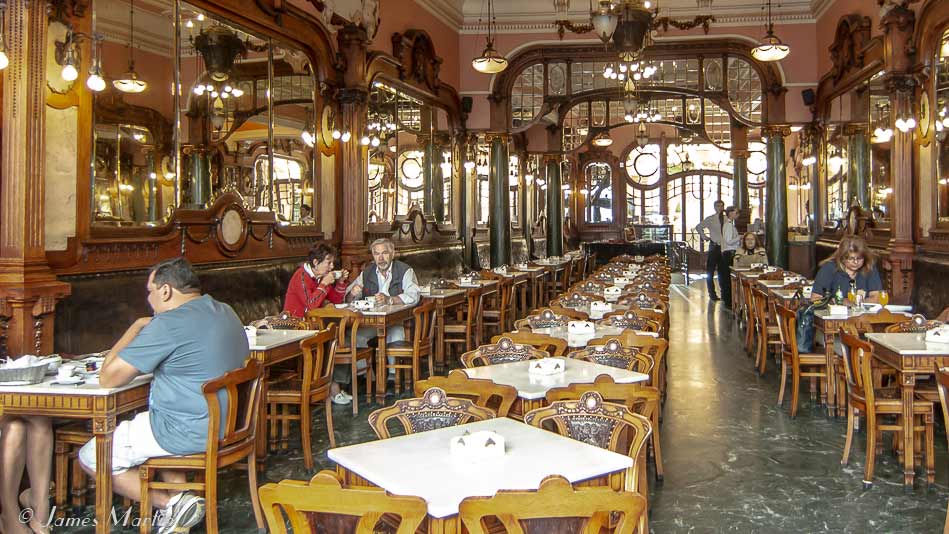
Undoubtedly the most famous coffee in Porto. Everyone knows this place. This pretty cafe dates back to 1921, although when it opened its doors the first year it was called Elite.
This place has a Parisian atmosphere, art nouveau design from the twenties and is inspired by the Belle-Epoque, a typical architectonic style of social gathering cafes of the time. It is covered with mirrors from Amberes, marble floors from India, carved wood, and stunning lampshades, decorations and a cute backyard.
In this highly refined environment, all kinds of personalities and intellectuals met.
This building was declared a Cultural Heritage site in 1983.
Placed at Rua Santa Catarina, pedestrian street, where you will very likely find huge waiting lines on high season just to enter and have a coffee, since it is very crowded due to its beauty. It’s definitely overpriced for the Portuguese standards, but it has an atmosphere that will blow up your mind.
Guarany Café
This cafe located at Avenida dos Aliados was inaugurated in 1933, and it is one of the oldest cafes in Porto. Its decorative theme alludes to one of the native indigenous tribes of South America, the Guarani, and specifically honors the country of Brazil, since it was the largest coffee exporter in the world during the 20th century.
This was a cafe where intellectuals met with musicians and artists of those times.
It also has a terrace with wonderful views to the busy Avenida de los Aliados where you can see the beautiful City Hall building that presides it. You can also glimpse from there many other buildings with a majestic looking like architecture from the 19th and 20th centuries. Having a coffee with those views will be worth it.
Performances of Fado shows also take place as well. And they have a recommended daily menu.
Ceuta Café
It was inaugurated in 1953. It is known that this cafe was frequented by politicians and artists of the time, since it was one of the most prominent cultural meeting places. This cafe makes you travel back in time, although at some point remodelling was inevitable but it still maintains the original aesthetic of the 50s. You can still find the original wooden furniture, paintings and decorations, mirrors and marbles.
Many decorations were inspired by the Portuguese conquest of the city of Ceuta (year 1415), the country's first colony, located in the North Africa, although today being Spanish territory.
This cafe is located at Ceuta street (Rua de Ceuta), as it lives up to its name. The cafe is very easy to spot due to its large dazzling neon panel, honoring the 50s.
During the week they have a fairly substantial lunch menu with several dishes to choose from for reasonable prices.